

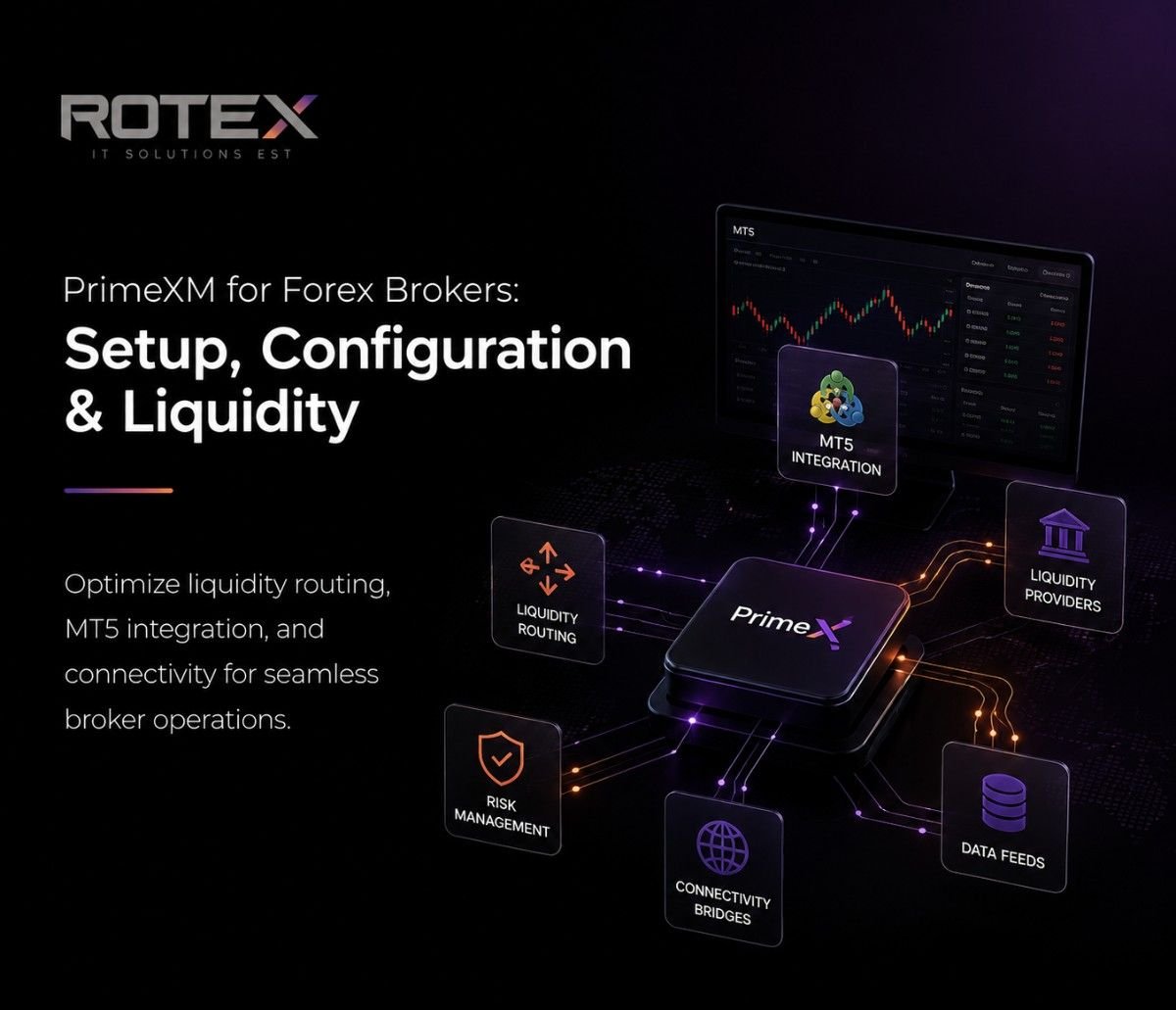
| Quick Answer PrimeXM setup for forex brokers involves configuring its XCore bridge to connect the trading platform (typically MT5 or MT4) to multiple liquidity providers, setting markup and routing rules, and integrating pricing feeds with the broker’s risk management system. |
Table of Contents
● What Is PrimeXM?
● How PrimeXM’s XCore Bridge Works
● Setting Up PrimeXM Liquidity Connections
● Integrating PrimeXM With MT5
● Managing Routing and Risk
● PrimeXM Analytics for Liquidity Provider Review
● Scaling PrimeXM Configuration as Volume Grows
● PrimeXM Implementation Timeline
● PrimeXM’s Role in Institutional Broker Setups
● PrimeXM’s FIX API Depth for Custom Routing
● Combining PrimeXM With a Dedicated Risk System
● PrimeXM’s Analytics for Compliance Reporting
● Frequently Asked Questions
What Is PrimeXM?
PrimeXM for Forex brokers is one of the most established liquidity bridge and aggregation technology providers in the forex industry, best known for its XCore bridge connecting trading platforms to institutional liquidity providers. It’s a core part of the Gateway & Bridge layer for many mid-size and larger brokers.
How PrimeXM’s XCore Bridge Works
XCore connects to multiple liquidity providers simultaneously, normalizing and aggregating their feeds into a consolidated price stream, then applies broker-defined markup before pushing quotes to the trading platform — following the same forex liquidity aggregation approach used across the industry, but with PrimeXM’s specific routing and analytics tooling layered on top.
Setting Up PrimeXM Liquidity Connections
Setup involves establishing FIX API connections to each chosen liquidity provider, configuring aggregation rules (best-price, VWAP or custom logic), and defining markup per instrument and account group. Server placement matters significantly here — see our forex broker server architecture guide for how proximity to PrimeXM’s infrastructure affects latency.
Integrating PrimeXM With MT5
PrimeXM integrates natively with MT5 for Forex brokers and MT4, feeding aggregated liquidity directly into the trading server while also exposing analytics on execution quality, rejection rates and slippage per liquidity provider — data that should feed into the broker’s Risk Management Software .
Managing Routing and Risk
PrimeXM supports the routing rules needed to implement an A-Book vs B-Book vs hybrid model strategy, directing flagged or high-risk accounts to full A-Book execution while internalizing lower-risk retail flow, with ongoing monitoring for toxic flow forex broker patterns.
PrimeXM Analytics for Liquidity Provider Review
PrimeXM’s built-in analytics suite gives brokers granular visibility into each liquidity provider’s fill rate, average slippage and rejection patterns broken down by instrument and time of day. Reviewing this data on a regular cadence — rather than only when execution complaints arise — helps brokers proactively renegotiate LP terms or rebalance flow toward better-performing providers before client experience is affected.
Scaling PrimeXM Configuration as Volume Grows
As trading volume increases, brokers often need to revisit their PrimeXM aggregation and markup rules, since settings tuned for lower volume don’t always scale efficiently once order flow increases significantly. Periodic configuration review, ideally every time volume crosses a meaningful growth threshold, keeps execution quality consistent as the brokerage scales.
PrimeXM Implementation Timeline
A typical PrimeXM XCore implementation, including LP connections, aggregation configuration and MT5/MT4 integration, generally takes two to five weeks depending on how many liquidity providers are being connected simultaneously and whether the broker’s trading platform infrastructure is already in place.
PrimeXM’s Role in Institutional Broker Setups
PrimeXM is particularly common among brokers serving institutional or high-volume professional clients, where its detailed execution analytics and mature FIX API infrastructure support the kind of granular liquidity management that this client segment expects.
PrimeXM’s FIX API Depth for Custom Routing
Brokers with sophisticated routing needs can build custom logic directly against PrimeXM’s FIX API layer rather than relying solely on its standard configuration interface, giving technically capable teams more granular control over how specific instruments or client segments are routed.
Combining PrimeXM With a Dedicated Risk System
While PrimeXM provides execution analytics, many brokers pair it with a dedicated Risk Management Software platform for broader exposure monitoring across the full client book, since PrimeXM’s strength is specifically liquidity and execution rather than comprehensive risk management.
PrimeXM’s Analytics for Compliance Reporting
PrimeXM’s execution and slippage reporting can support best-execution compliance documentation in jurisdictions where brokers must demonstrate fair client execution, reducing the manual reporting burden on compliance teams.
Frequently Asked Questions
Does PrimeXM work with platforms other than MetaTrader?
Yes, PrimeXM supports integration with multiple trading platforms beyond MT4/MT5, though MetaTrader remains its most common deployment.
How many liquidity providers can be connected through PrimeXM?
Brokers typically connect anywhere from a handful up to dozens of LPs depending on their volume and instrument coverage needs.