

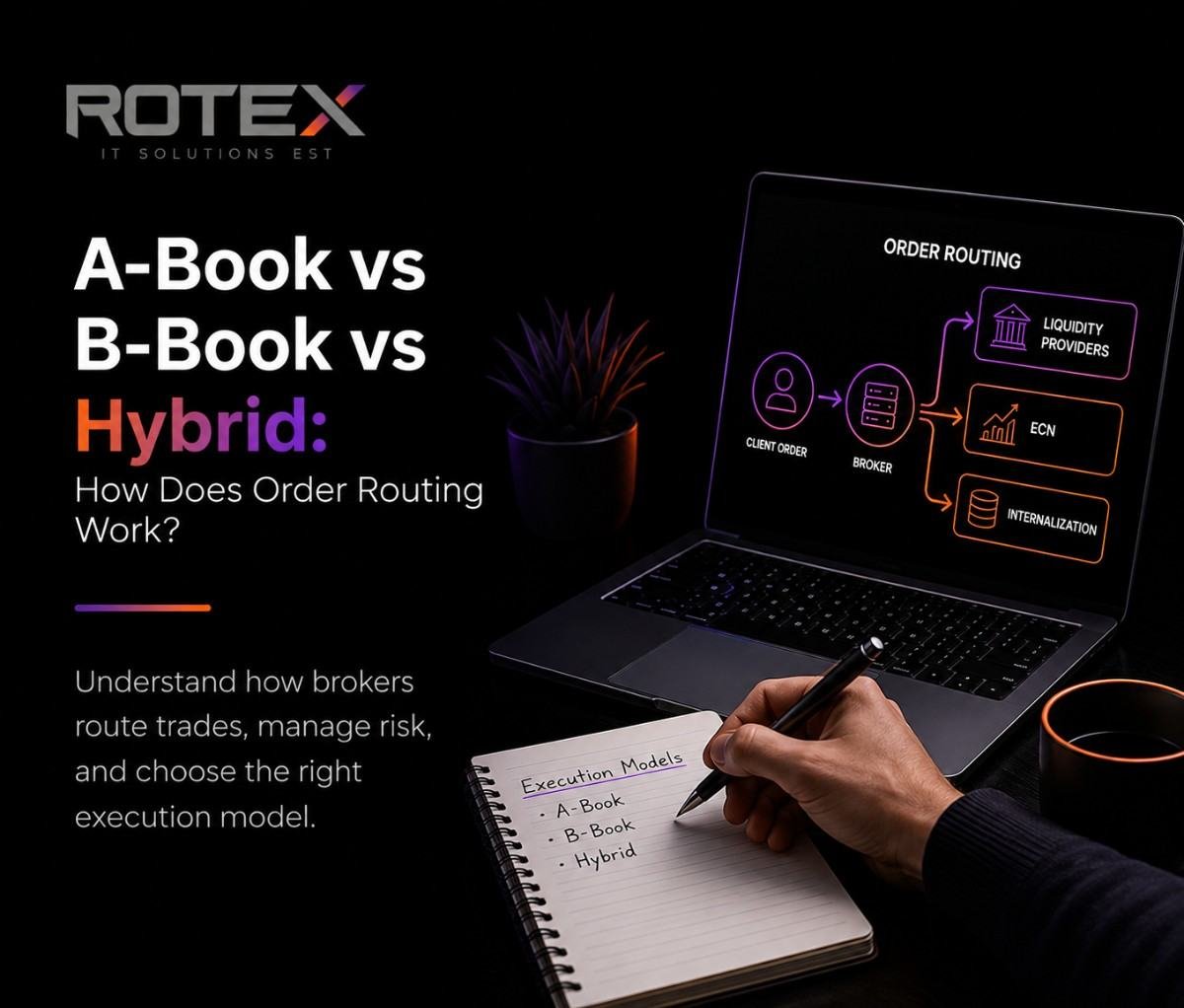
| Quick Answer A-Book routes client orders directly to external liquidity providers so the broker earns from spreads/commissions with no market risk. B-Book keeps orders internal, meaning the broker takes the opposite side and profits when clients lose. A hybrid model routes flow dynamically between the two based on trader behavior and risk profiling, which is how most modern brokers actually operate. |
Table of Contents
● What Do A-Book, B-Book and Hybrid Mean?
● How A-Book Routing Works
● How B-Book Routing Works
● The Hybrid Model in Practice
● Choosing the Right Routing Strategy
● Regulatory and Disclosure Considerations
● Capital and Risk Reserve Planning
● Client Communication Around Execution Model
● Reviewing Model Performance Quarterly
● Aligning Sales and Risk Team Incentives
● Frequently Asked Questions
What Do A-Book, B-Book and Hybrid Mean?
In A book B book hybrid model routing, A-Book means every client order is passed through to a liquidity provider, so the broker earns purely from spread markup or commission and carries no directional market risk. B-Book means the broker internalizes the order and becomes the counterparty, profiting when the client’s position loses money. A hybrid model blends both, routing individual clients or trade sizes to whichever book suits their trading pattern.
This decision sits directly on top of the Risk Management Software and Gateway & Bridge layers of the broker’s stack.
How A-Book Routing Works
Under A-Book, every order passes through the bridge to one or more connected LPs, following the same forex liquidity aggregation logic used broker-wide. Because the broker isn’t taking the other side of the trade, profitability depends entirely on volume and consistent spread capture rather than client losses. A-Book is generally preferred for high-frequency, well-capitalized or professional clients whose trading patterns could otherwise create large directional exposure if internalized.
The trade-off is thinner margins per trade and full dependency on liquidity provider execution quality.
How B-Book Routing Works
B-Book keeps flow inside the brokerage, which is common for retail clients trading small sizes with high loss rates — statistically the majority of retail forex traders. The broker’s Risk Management Software monitors aggregate internal exposure across all B-Booked clients and can selectively hedge externally if net exposure on a currency pair grows too large.
B-Book carries real market risk, so it requires continuous exposure monitoring; without it, a broker can be caught badly exposed if a large number of clients happen to win simultaneously, for example during a strong trending move.
The Hybrid Model in Practice
Most modern brokerages run a hybrid model, using behavioral analytics to score each client on factors like win rate, trade size, holding time and strategy type. Clients who show consistent profitability or scalping/arbitrage patterns are routed A-Book to remove risk, while lower-risk retail flow stays B-Book. This scoring typically runs continuously inside the RMS and can re-route a client automatically as their trading pattern changes.
Our guide to managing toxic flow forex broker covers exactly how brokers detect the trading patterns — like latency arbitrage — that should be routed A-Book immediately.
Choosing the Right Routing Strategy
The right mix depends on client base, capital reserves and risk appetite. Brokers with strong capital buffers and sophisticated risk tooling can run more B-Book flow profitably, while smaller or newer brokers often start closer to full A-Book to limit downside while building trading history and risk data. Whichever model you choose, routing rules should live in your Gateway & Bridge configuration so decisions are applied consistently and automatically rather than manually.
This connects to the broader forex broker technology stack, since routing logic only works reliably when liquidity, CRM and risk systems are properly integrated.
Regulatory and Disclosure Considerations
Regulators in most major jurisdictions require brokers to disclose their dealing model — whether they act as principal (B-Book) or agent (A-Book) — in client-facing terms and conditions. Transparency here isn’t just a compliance checkbox; it also shapes client trust, since sophisticated traders increasingly research a broker’s execution model before opening an account.
Brokers running a hybrid model should ensure their disclosures accurately reflect that client routing can change based on trading behavior, rather than implying a fixed A-Book or B-Book policy that doesn’t match how the system actually operates in practice.
Capital and Risk Reserve Planning
Running any meaningful B-Book exposure requires holding capital reserves sized to absorb short-term losses when a cluster of clients happens to win simultaneously — a realistic scenario during strong trending markets. Brokers should stress-test their reserve levels against historical volatility spikes rather than assuming average daily P&L patterns will hold during outlier events.
This capital planning should be reviewed alongside the broker’s overall Risk Management Software configuration, since exposure limits and reserve requirements are two sides of the same risk framework.
Client Communication Around Execution Model
Clients increasingly ask brokers directly how their orders are executed, and a clear, honest answer — even acknowledging a hybrid model — tends to build more trust than vague or evasive responses. Support teams should be briefed on how to explain the broker’s model accurately without disclosing proprietary routing thresholds.
Reviewing Model Performance Quarterly
Brokers should periodically review the profitability and risk profile of their A-Book versus B-Book flow separately, since a hybrid model that isn’t working as intended often shows up first as unexplained margin compression in one book rather than the other.
Aligning Sales and Risk Team Incentives
Sales teams focused purely on client acquisition and risk teams focused on exposure control can end up with conflicting incentives under a hybrid model, so clear internal policy on how routing decisions are made — and by whom — prevents disputes between departments over individual client classifications.
Frequently Asked Questions
Is B-Book trading illegal?
No — B-Book is a standard, regulated dealing model used by many licensed brokers worldwide, provided it is disclosed appropriately and risk is actively managed.
Can a broker switch a client between A-Book and B-Book?
Yes, hybrid models routinely re-classify clients as their trading behavior changes, based on ongoing analysis inside the risk management system.