

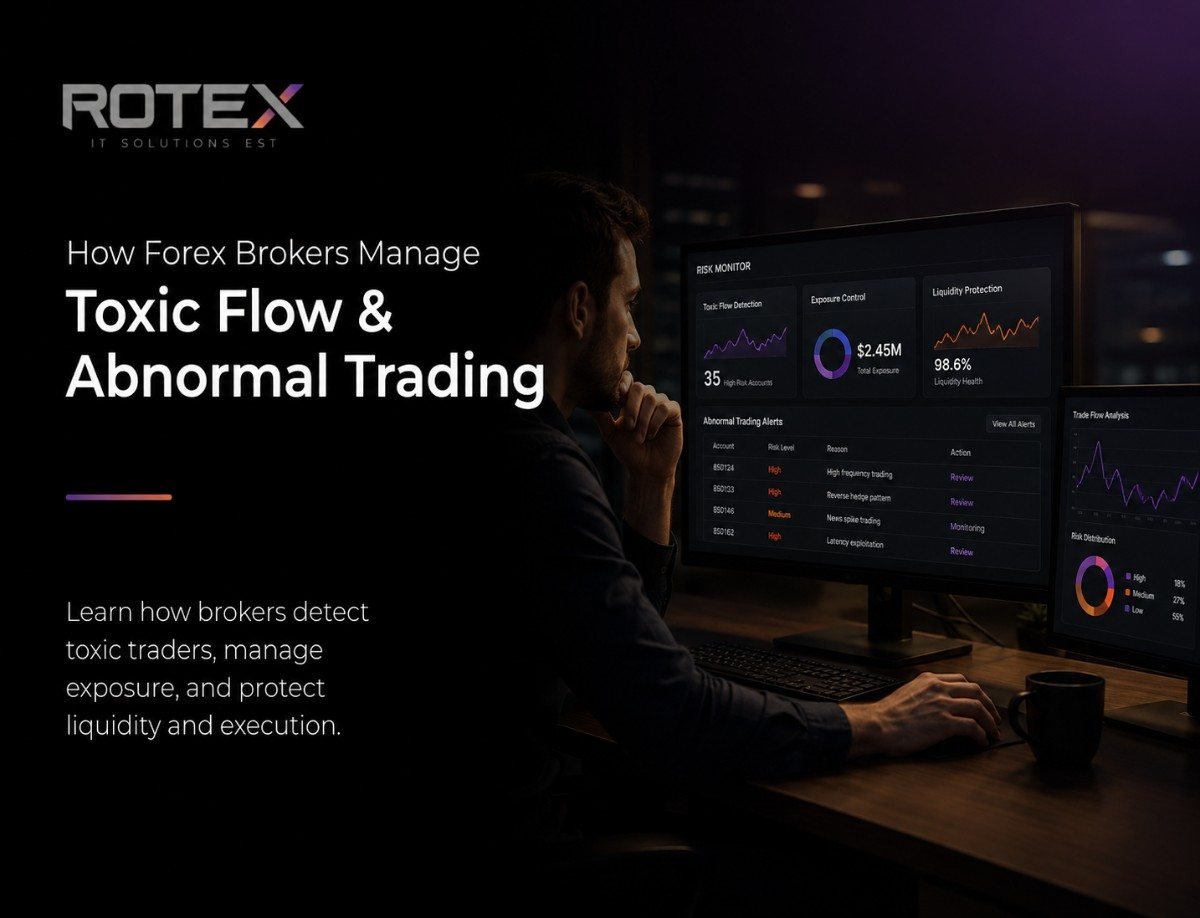
| Quick Answer Toxic flow in forex refers to trading activity — such as latency arbitrage, news-spike exploitation or coordinated multi-account trading — that consistently profits from pricing or execution weaknesses rather than genuine market views. Brokers detect it through pattern analysis in their risk management software and typically respond by re-routing the client to A-Book execution or adjusting their trading conditions. |
Table of Contents
● What Is Toxic Flow?
● Common Types of Toxic Trading Activity
● How Brokers Detect Toxic Flow
● Responding to Toxic Flow Without Losing Legitimate Clients
● Building Toxic Flow Detection Into Your Risk System
● Setting Practical Detection Thresholds
● Documenting Toxic Flow Decisions
● Training Dealing Desk Staff on Pattern Recognition
● Balancing Detection Sensitivity Over Time
● Cross-Referencing Flow Analysis With Liquidity Data
● Frequently Asked Questions
What Is Toxic Flow?
Toxic flow forex broker activity describes trading that consistently exploits pricing latency, feed delays or execution gaps rather than reflecting genuine directional views on the market. Left unmanaged, toxic flow can turn what looks like profitable B-Book client activity into a steady drain on broker capital, since these traders win with statistical regularity that ordinary retail clients don’t.
Common Types of Toxic Trading Activity
Latency arbitrage exploits the delay between a broker’s quoted price and the true interbank price, typically using automated scripts that fire the instant a stale quote appears. News-spike exploitation targets the brief window around major economic releases when spreads widen unpredictably. Coordinated multi-account trading spreads a single strategy across many linked accounts to disguise the pattern from standard monitoring. Each of these behaves very differently from ordinary discretionary retail trading.
How Brokers Detect Toxic Flow
Detection relies on the broker’s Risk Management Software flagging statistical anomalies — unusually high win rates, extremely short holding times correlated with price spikes, or trading patterns that consistently precede adverse price moves against the broker’s book. This analysis needs access to granular trade-level data, which is why it depends on tight integration between the trading platform and RMS, as described in our forex broker technology stack guide.
Responding to Toxic Flow Without Losing Legitimate Clients
The most common response is re-routing flagged accounts from B-Book to A-Book execution, which removes the broker’s exposure to that client’s edge without necessarily terminating the relationship — a decision explained fully in our A-Book vs B-Book vs hybrid model guide. Brokers should be careful to distinguish genuinely toxic patterns from simply skilled or high-frequency but legitimate trading, since over-flagging damages relationships with profitable, rule-abiding clients.
Building Toxic Flow Detection Into Your Risk System
Effective detection requires real-time trade tagging, correlation analysis against interbank price feeds, and configurable thresholds that trigger automatic routing changes rather than relying on manual dealing-desk review of every account. This ties directly into the Gateway & Bridge layer, since routing rules need to update the moment a client is reclassified, and into your broader forex liquidity aggregation setup, since toxic flow often exploits inconsistencies between LP feeds.
Setting Practical Detection Thresholds
Effective toxic flow detection depends on setting thresholds that are strict enough to catch genuine abuse but loose enough to avoid flagging normal high-frequency or skilled discretionary trading. Thresholds based purely on win rate, for instance, risk flagging simply talented traders; combining win rate with holding time, trade timing relative to news events, and correlation with adverse price movement produces a far more reliable signal.
Most brokers refine these thresholds iteratively, starting conservative and tightening detection rules as they build a clearer picture of what genuinely toxic patterns look like within their specific client base and instrument mix.
Documenting Toxic Flow Decisions
Every re-routing or account restriction decision tied to suspected toxic flow should be documented with the specific data that triggered it — this protects the broker if a client disputes the decision and provides a consistent record for compliance review. Ad hoc, undocumented flagging decisions are difficult to defend and can create inconsistency across the dealing desk.
This documentation discipline pairs naturally with the routing logic covered in our A-Book vs B-Book vs hybrid model guide, since re-routing decisions are easier to justify when tied to clear, pre-agreed criteria.
Training Dealing Desk Staff on Pattern Recognition
Even with automated detection tools, dealing desk staff benefit from training on what toxic flow patterns look like in practice, since human review often catches edge cases that automated thresholds miss, particularly novel strategies that haven’t been seen before.
Balancing Detection Sensitivity Over Time
Detection thresholds that were appropriate at launch often need loosening or tightening as a broker’s client base and instrument offering evolve, so treating toxic flow detection as a static, one-time configuration rather than an ongoing tuning process is a common and costly oversight.
Cross-Referencing Flow Analysis With Liquidity Data
Comparing internal toxic flow flags against liquidity provider execution data often reveals whether flagged activity correlates with genuine feed inefficiencies on the broker’s side, which is important context before permanently restricting a client’s trading conditions.
Frequently Asked Questions
Is latency arbitrage illegal?
It isn’t illegal in most jurisdictions, but brokers are generally permitted to restrict or re-route accounts engaging in it under their terms of service, since it exploits a technical execution gap rather than genuine market analysis.
How quickly should toxic flow be detected?
Ideally within days of a pattern emerging — the longer flagged flow stays on B-Book, the larger the potential cumulative loss to the broker’s book.