

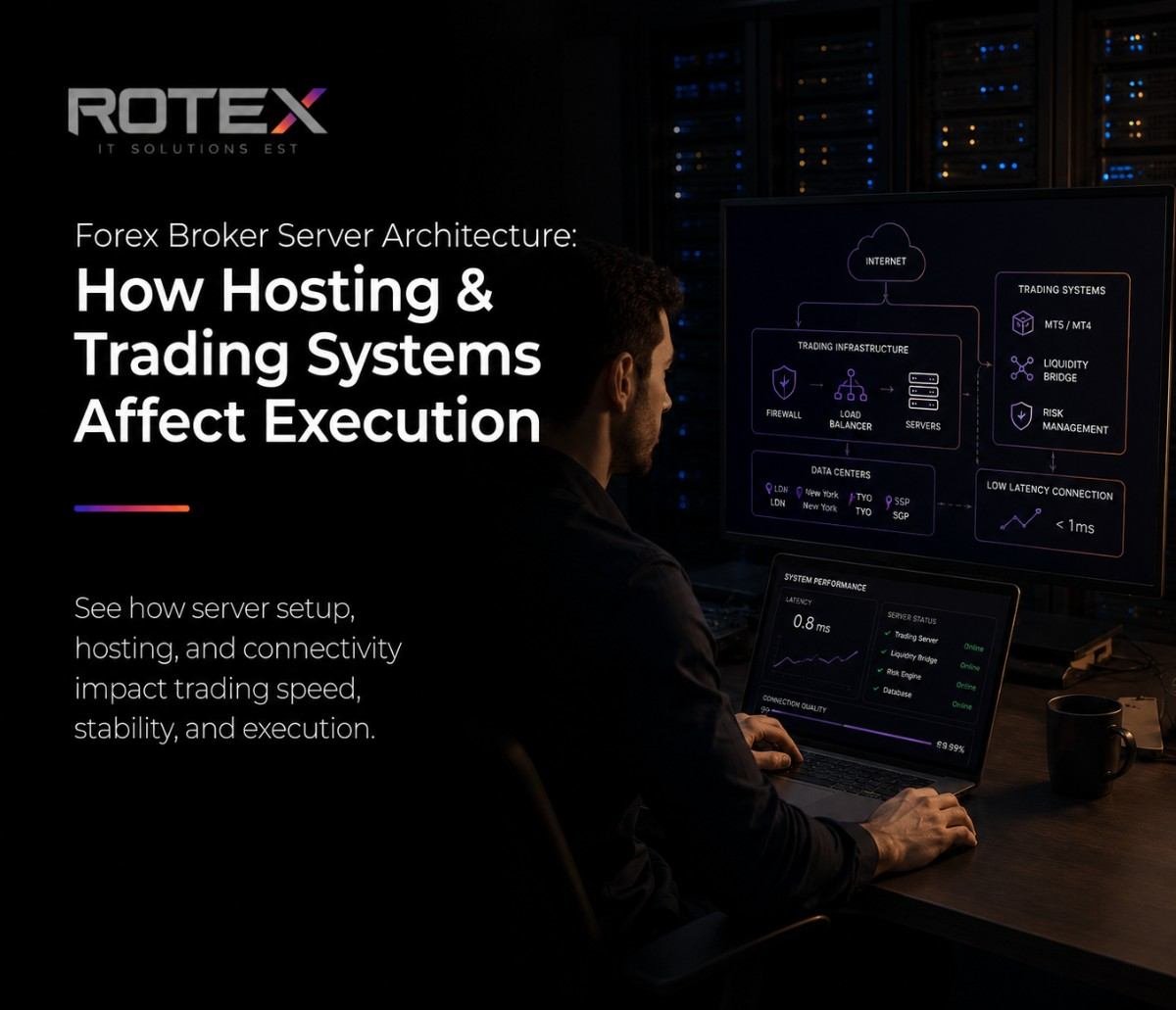
| Quick Answer Forex broker server architecture refers to how the trading platform server, liquidity connections and CRM are hosted and networked together. Server location relative to liquidity providers, redundancy setup, and network quality directly determine execution latency, slippage and platform uptime — making hosting one of the most overlooked factors in trade execution quality. |
Table of Contents
● Why Server Architecture Affects Execution
● Core Elements of Broker Server Architecture
● Server Location and Latency
● Redundancy and Uptime Planning
● Common Server Architecture Mistakes
● Monitoring and Alerting Infrastructure
● Disaster Recovery Planning
● Planning for Seasonal and Event-Driven Volume Spikes
● Budgeting for Infrastructure Growth
● Working With Specialized Financial Hosting Providers
● Frequently Asked Questions
Why Server Architecture Affects Execution
Forex broker server architecture determines how quickly price updates and order confirmations travel between the liquidity provider, the trading platform, and the client. Even a well-configured forex broker technology stack will underperform if the underlying servers are poorly located or under-provisioned, since latency shows up directly as slippage and requotes that clients notice immediately.
Core Elements of Broker Server Architecture
The main components are the trading platform server (MT5/MT4/cTrader), the bridge or gateway server that connects to liquidity providers, the CRM and database servers, and the network links between all of them. Best practice is placing the trading platform and bridge servers in the same data center as, or with a low-latency connection to, your primary liquidity providers, since even single-digit millisecond differences compound across thousands of daily trades.
Server Location and Latency
Data centers in financial hubs like London (LD4/LD5), New York (NY4) and Equinix locations in Asia are common choices specifically because major liquidity providers and prime brokers colocate there. Hosting a trading server far from your primary LPs — for example on a different continent — adds round-trip latency that directly increases slippage, particularly on fast-moving instruments. This is a key factor covered further in our guide to forex liquidity aggregation.
Redundancy and Uptime Planning
A production broker setup needs failover servers, redundant network paths and real-time database replication, so a single hardware or connectivity failure doesn’t take the whole platform offline during trading hours. Downtime during high-volatility periods is when brokers face the highest client complaint volume and, in some jurisdictions, regulatory scrutiny — making redundancy a compliance issue as much as a technical one.
Common Server Architecture Mistakes
Under-provisioning server capacity for peak trading volume (news events, market opens) is common and leads to platform slowdowns exactly when clients need reliability most. Skipping proper monitoring and alerting is another frequent gap — many brokers only discover a connectivity issue when clients complain, rather than through automated alerts. Server architecture decisions should be made alongside your Trading Platforms and liquidity setup, not treated as a separate IT afterthought.
See our platform-specific setup guides, including MT5 for Forex brokers and MT4 for Forex brokers , for hosting recommendations specific to each platform.
Monitoring and Alerting Infrastructure
Beyond raw server capacity, brokers need real-time monitoring covering server CPU and memory load, network latency to each liquidity provider, and API connection health between the trading platform, bridge and CRM. Automated alerts — rather than manual dashboard checks — ensure technical teams are notified the moment a metric crosses a safe threshold, well before clients notice degraded execution.
Many brokers underinvest in monitoring relative to the core trading infrastructure itself, only to find that the first sign of a developing problem is a spike in client complaints rather than an internal alert — by which point the issue has already affected trading quality.
Disaster Recovery Planning
A complete server architecture plan includes a documented disaster recovery process — how quickly a failover server can take over if the primary fails, how database replication is verified, and how client communication is handled during an outage. Testing this process periodically, rather than only relying on it during an actual emergency, is what separates a broker that recovers within minutes from one that faces hours of downtime during a critical trading period.
This planning should be reviewed alongside your forex broker technology stack as a whole, since a server failure that isn’t isolated properly can cascade into CRM and payment system issues as well.
Planning for Seasonal and Event-Driven Volume Spikes
Server capacity should be planned not just for average daily volume but for predictable spikes around major economic releases, central bank announcements and periods of elevated market volatility, when order volume and price update frequency can multiply well beyond typical levels within minutes.
Budgeting for Infrastructure Growth
Server and network costs should be modeled against realistic multi-year growth projections rather than current volume alone, since under-budgeting infrastructure investment is one of the more common reasons brokers face a disruptive, reactive server migration during a period of rapid client growth.
Working With Specialized Financial Hosting Providers
Rather than general-purpose cloud hosting, most brokers work with hosting providers specializing in financial trading infrastructure, since these providers understand the specific latency, uptime and colocation requirements that generic cloud platforms aren’t optimized for.
Frequently Asked Questions
How much does server location affect execution speed?
Meaningfully — moving a trading server from a distant region into the same data center as your primary liquidity provider can cut round-trip latency from tens of milliseconds to under a millisecond.
Do small or new brokers need redundant servers from day one?
It’s strongly recommended, since retrofitting redundancy after clients and trading history exist is far more disruptive than building it in from launch.