

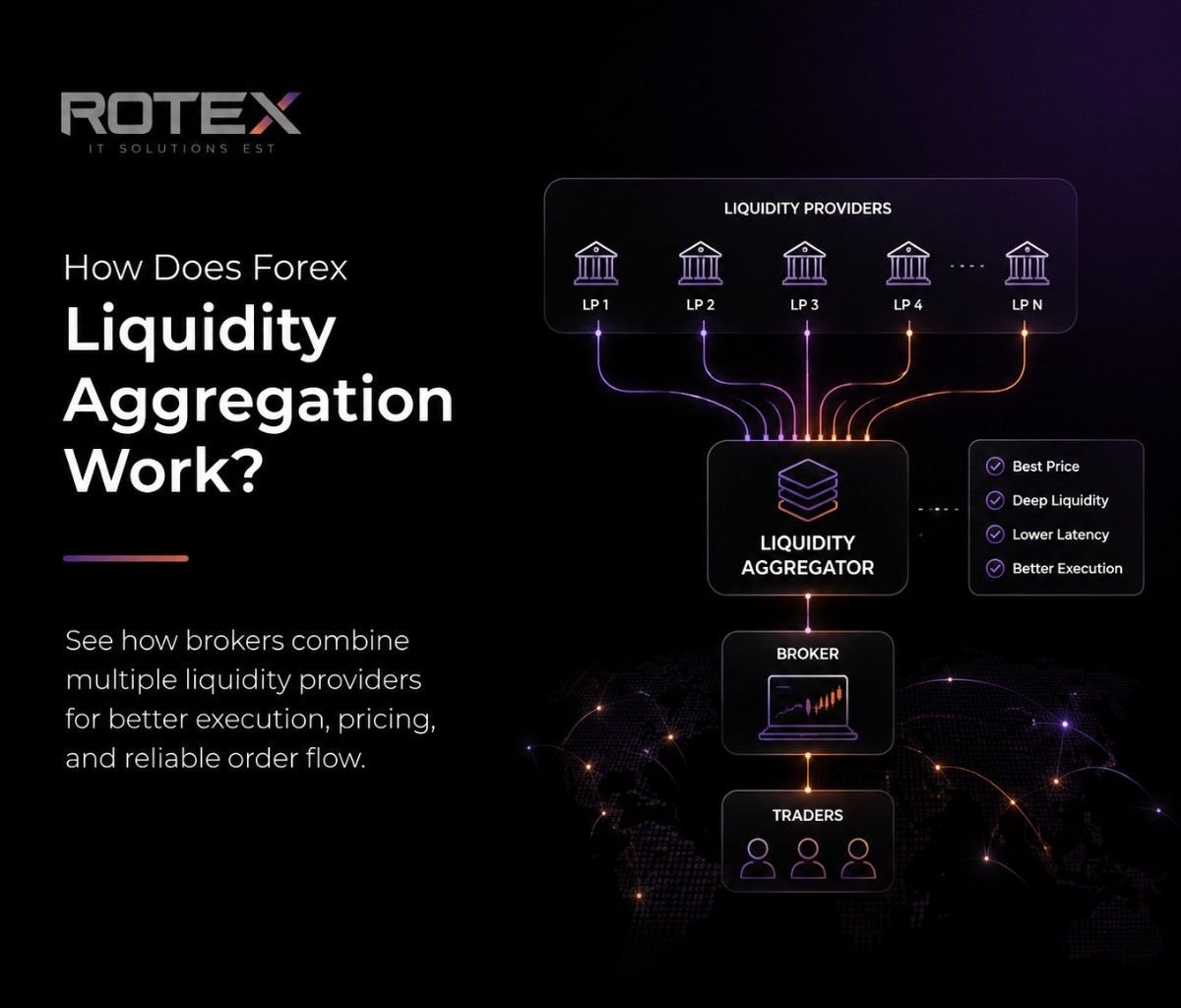
| Quick Answer Forex liquidity aggregation is the process of combining pricing and depth from multiple liquidity providers into a single consolidated order book, using a bridge or aggregation engine. It gives brokers tighter spreads, more resilient execution, and protection against the failure or widening of any single LP, rather than depending on one source for every trade. |
Table of Contents
● What Is Liquidity Aggregation?
● Why Brokers Use Multiple Liquidity Providers
● How the Aggregation Process Works
● Common Liquidity Aggregation Mistakes
● Choosing and Managing LP Relationships
● Measuring Liquidity Quality Over Time
● Aggregation Models: Best Price vs VWAP vs Custom
● Negotiating Terms With Liquidity Providers
● Handling LP Outages Gracefully
● Setting Up Failback and Redundancy Rules
● Frequently Asked Questions
What Is Liquidity Aggregation?
Forex liquidity aggregation is the practice of pulling live price feeds from several liquidity providers (LPs) — typically banks, non-bank market makers and prime brokers — and merging them into one consolidated book inside a bridge or aggregation engine. Instead of quoting clients off a single feed, the broker’s pricing engine picks the best available bid and ask across all connected LPs at any moment.
This sits at the center of the broader forex broker technology stack, since pricing quality directly affects client trust, execution complaints and, ultimately, retention.
Why Brokers Use Multiple Liquidity Providers
Relying on one LP creates a single point of failure: if that provider widens spreads during volatility, goes offline, or reduces credit lines, the broker’s entire client base feels it immediately. Aggregating several LPs spreads that risk, deepens the available volume at each price level, and lets brokers route different instruments or client segments to whichever LP prices them most competitively.
It also supports the routing decisions covered in our guide to A-Book vs B-Book vs hybrid model, where A-Book flow needs reliable external liquidity while B-Book flow is handled internally.
How the Aggregation Process Works
A bridge or aggregation engine connects to each LP via FIX API or a proprietary protocol, normalizes the incoming price feeds into a common format, and builds a merged depth-of-market ladder. The broker’s pricing engine then applies a markup and pushes a single consolidated quote to the trading platform (MT5, MT4, cTrader and similar). When a client trades, the engine decides — based on pre-set rules — whether to route the order to a specific LP, split it across several, or internalize it.
This routing logic is closely tied to Gateway & Bridge configuration, and to server placement discussed in our piece on forex broker technology stack.
Common Liquidity Aggregation Mistakes
The most frequent mistake is aggregating LPs with mismatched pricing conventions or update speeds, which produces inconsistent spreads that clients notice immediately. Another is failing to set proper last-look and rejection handling, leading to slippage disputes. Brokers also sometimes add LPs purely for redundancy without monitoring fill rates, which means a poorly performing provider quietly drags down average execution quality across the whole book.
Our article on managing toxic flow forex broker explains how uneven liquidity setups can also be exploited by latency arbitrage traders.
Choosing and Managing LP Relationships
Evaluate LPs on fill ratio, average rejection rate, spread consistency during news events, and credit terms — not on headline spread alone. Most brokers maintain three to five active LPs per instrument group so that any single relationship can be paused or renegotiated without disrupting client execution. Regularly reviewing LP performance data alongside your Risk Management Software output helps catch degradation before clients do.
For platform-specific liquidity setup, see our guides on connecting PrimeXM for Forex brokers, oneZero for Forex brokers and Centroid for Forex brokers.
Measuring Liquidity Quality Over Time
Aggregating liquidity providers is not a one-time setup — execution quality needs to be tracked continuously through metrics like fill ratio, average rejection rate, and spread consistency during both quiet and volatile market conditions. A liquidity provider that performs well during normal trading hours can behave very differently during major news releases, and brokers who only review LP performance during calm periods often get an incomplete picture.
Most bridge and aggregation platforms provide dashboards showing these metrics per LP and per instrument, and reviewing them monthly — rather than only when clients complain — helps brokers catch degrading liquidity relationships early enough to renegotiate terms or add a replacement provider before execution quality visibly suffers.
Aggregation Models: Best Price vs VWAP vs Custom
Bridges typically support several aggregation logics: best-price, which simply selects the tightest bid/ask across connected LPs; volume-weighted average price (VWAP), which blends pricing across providers weighted by available depth; and custom logic that lets brokers prioritize specific LPs for specific instruments or client tiers. The right choice depends on trading volume and instrument mix — best-price suits brokers prioritizing headline spread competitiveness, while VWAP often produces steadier execution for higher-volume accounts.
Whichever model is chosen, it should be reviewed periodically against real execution data rather than left on default settings indefinitely, since market conditions and LP relationships both change over time.
Negotiating Terms With Liquidity Providers
Beyond spread and commission terms, brokers should negotiate credit lines, margin requirements and notice periods for any changes to pricing or connectivity. Providers that can adjust terms with little warning create planning risk, so contractual clarity on notice periods protects the broker’s ability to react before execution quality degrades unexpectedly.
Handling LP Outages Gracefully
Even well-managed liquidity relationships occasionally experience outages, so brokers should configure automatic failover to remaining connected LPs rather than allowing a single provider’s downtime to halt pricing entirely. Testing this failover periodically, not just assuming it will work, is the only way to be confident it performs correctly during an actual outage.
Setting Up Failback and Redundancy Rules
Beyond spreading trades across multiple LPs, brokers should configure explicit failback rules specifying exactly which provider takes over first, second and third if a primary LP becomes unavailable, tested under simulated outage conditions rather than assumed to work correctly by default.
Frequently Asked Questions
How many liquidity providers should a forex broker use?
Most established brokers run three to five LPs per major instrument group, balancing depth against the operational overhead of managing multiple relationships.
Does liquidity aggregation guarantee better spreads?
Not automatically — spreads only improve if the aggregation engine is correctly configured to select the best available price rather than simply averaging feeds.